
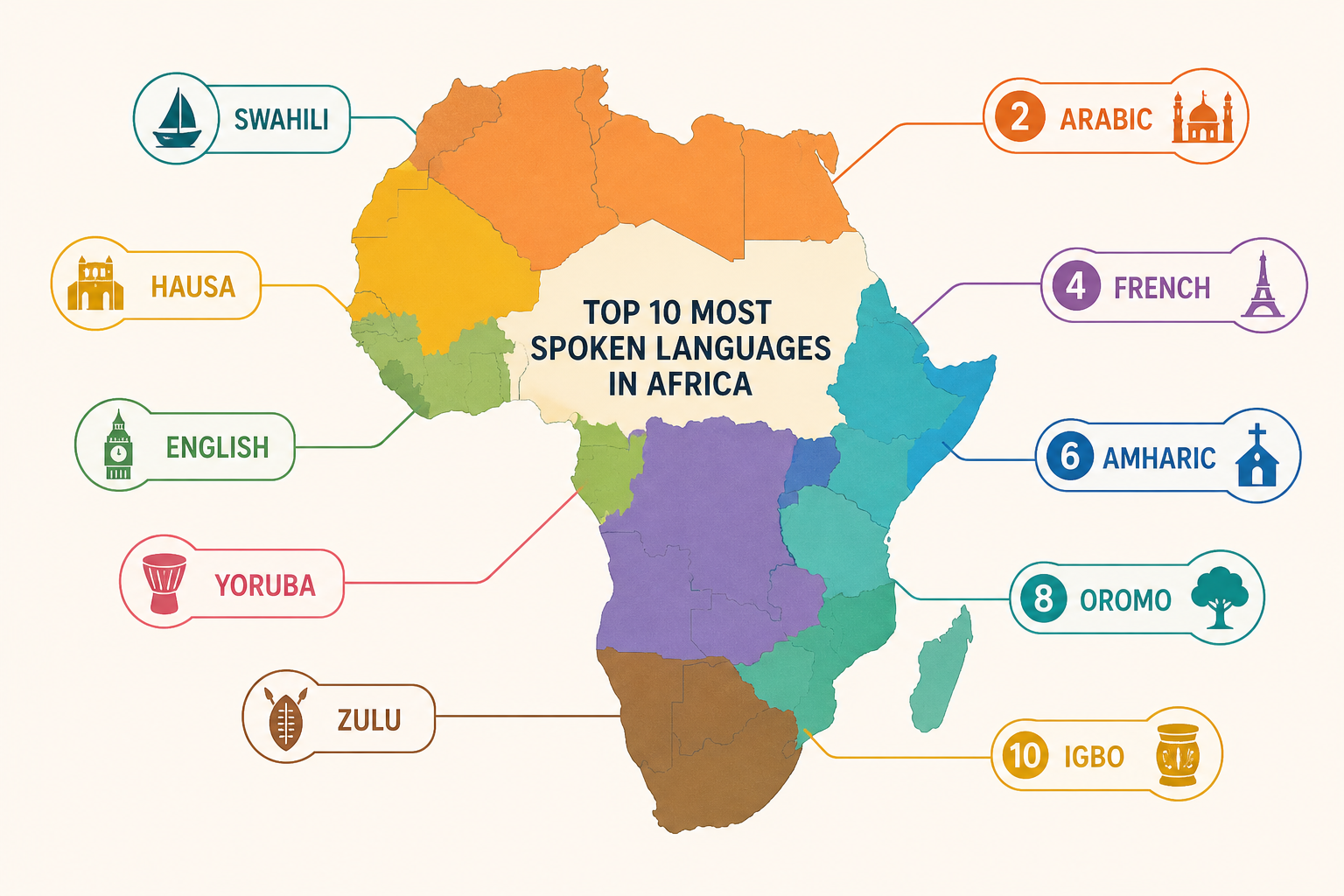
Africa is one of the most linguistically diverse regions in the world, home to over 2,000 languages spoken across more than 50 countries. This diversity reflects the continent’s rich cultural heritage, complex history, and vast population. When discussing the most spoken languages in Africa, it is important to distinguish between native speakers and total speakers (which includes second-language users). Many African languages serve as regional lingua francas, meaning they are widely used for communication between people of different ethnic groups.
The Most Spoken Languages in Africa
1. Swahili (Kiswahili)
Swahili is widely regarded as the most spoken language in Africa when counting total speakers. It is a Bantu language with strong Arabic influences, reflecting centuries of trade along the East African coast. Swahili is spoken by over 200 million people, mostly as a second language, across countries such as Tanzania,
Swahili plays a key role in regional communication, education, media, and politics. It is also one of the official languages of the African Union, making it highly influential across the continent.
2. Arabic
Arabic is another major language spoken across North Africa and parts of the Horn of Africa. It is the dominant language in countries such as Egypt, Algeria, Morocco, and Sudan.
With over 150 million speakers in Africa, Arabic exists in multiple dialects, often differing significantly from Modern Standard Arabic. It is widely used in religion (especially Islam), governance, and media, contributing to its widespread adoption.
3. Hausa
Hausa is one of the most important languages in West Africa and serves as a lingua franca across the region. It is primarily spoken in Nigeria and Niger, but it is also widely understood in countries like Ghana and Cameroon.
Hausa has over 70 million native speakers and more than 100 million total speakers. It is used in trade, broadcasting, and daily communication, making it a powerful regional language.
4. French
French is one of the most widely spoken languages in Africa due to colonial history. It is an official language in more than 20 African countries, including Senegal, Ivory Coast, and Democratic Republic of the Congo.
Africa is now home to the largest number of French speakers in the world, with over 120 million people using it. It is commonly used in government, education, and international relations.
5. English
English is another major language spoken across Africa, especially in former British colonies such as Nigeria, South Africa, Kenya, and Ghana.
Although it may not have as many native speakers as indigenous languages, English is widely used as an official language and serves as a medium for business, education, and global communication.
6. Amharic
Amharic is the official language of Ethiopia and is spoken by over 30 million people. It is one of the few indigenous African languages used extensively in government and administration.
7. Yoruba
Yoruba is spoken by over 40 million people, mainly in Nigeria, as well as in parts of Benin and Togo. It is a major cultural and linguistic force in West Africa, with a strong presence in literature, religion, and diaspora communities.
8. Oromo
Oromo is one of the most widely spoken languages in Ethiopia and has over 35 million speakers. It plays a crucial role in the cultural identity of the Oromo people.
9. Zulu (isiZulu)
Zulu is one of the most widely spoken languages in Southern Africa, particularly in South Africa, where it is the most spoken home language. It has over 12 million native speakers and many more who understand it as a second language.
Zulu is part of the Nguni language group and is known for its rich oral traditions, music, and cultural influence. It is used in education, media, and daily communication, making it a key language in South Africa’s multicultural society.
10. Igbo
Igbo is a major language spoken in southeastern Nigeria, with over 30 million speakers. It is one of the largest indigenous languages in Africa and plays a vital role in cultural identity, commerce, and local governance in the region.
Igbo has a strong literary tradition and is widely used in broadcasting, education (at regional levels), and community interactions. It also has a global presence due to the African diaspora.
Factors Influencing Language Spread
Several factors explain why some languages are more widely spoken than others in Africa:
- Colonial history: Languages like English and French spread due to European colonization and remain official languages today.
- Trade and migration: Languages such as Swahili and Hausa expanded through trade routes and population movement.
- Religion: Arabic spread largely through the influence of Islam across North and parts of East and West Africa.
- Urbanization: As cities grow, lingua francas become essential for communication among diverse populations.
The Role of Lingua Francas
A key feature of Africa’s linguistic landscape is the use of lingua francas—languages adopted for communication between speakers of different native languages. Swahili in East Africa and Hausa in West Africa are prime examples. These languages help bridge communication gaps in multilingual societies.
Challenges and Opportunities
While Africa’s linguistic diversity is a strength, it also presents challenges in education, governance, and national unity. Many countries must balance the use of indigenous languages with colonial languages that offer global connectivity.
However, there is growing recognition of the importance of promoting African languages in schools, media, and technology. Efforts are being made to preserve endangered languages and integrate local languages into digital platforms.
Conclusion
The most spoken languages in Africa reflect a blend of indigenous heritage and historical influences. Swahili stands out as the most widely spoken language overall, while Arabic, Hausa, English, and French also play significant roles across different regions.
Africa’s linguistic diversity is not just a challenge—it is a powerful asset that showcases the continent’s cultural richness and adaptability. As globalization continues, the importance of both local and international languages will only grow, shaping Africa’s future in communication, education, and development.
- Follow me on TikTok for quick tips and behind-the-scenes tours
- Subscribe to my YouTube channel for in-depth videos and property showcases
- Follow me on Facebook for updates, listings, and real estate advice
