
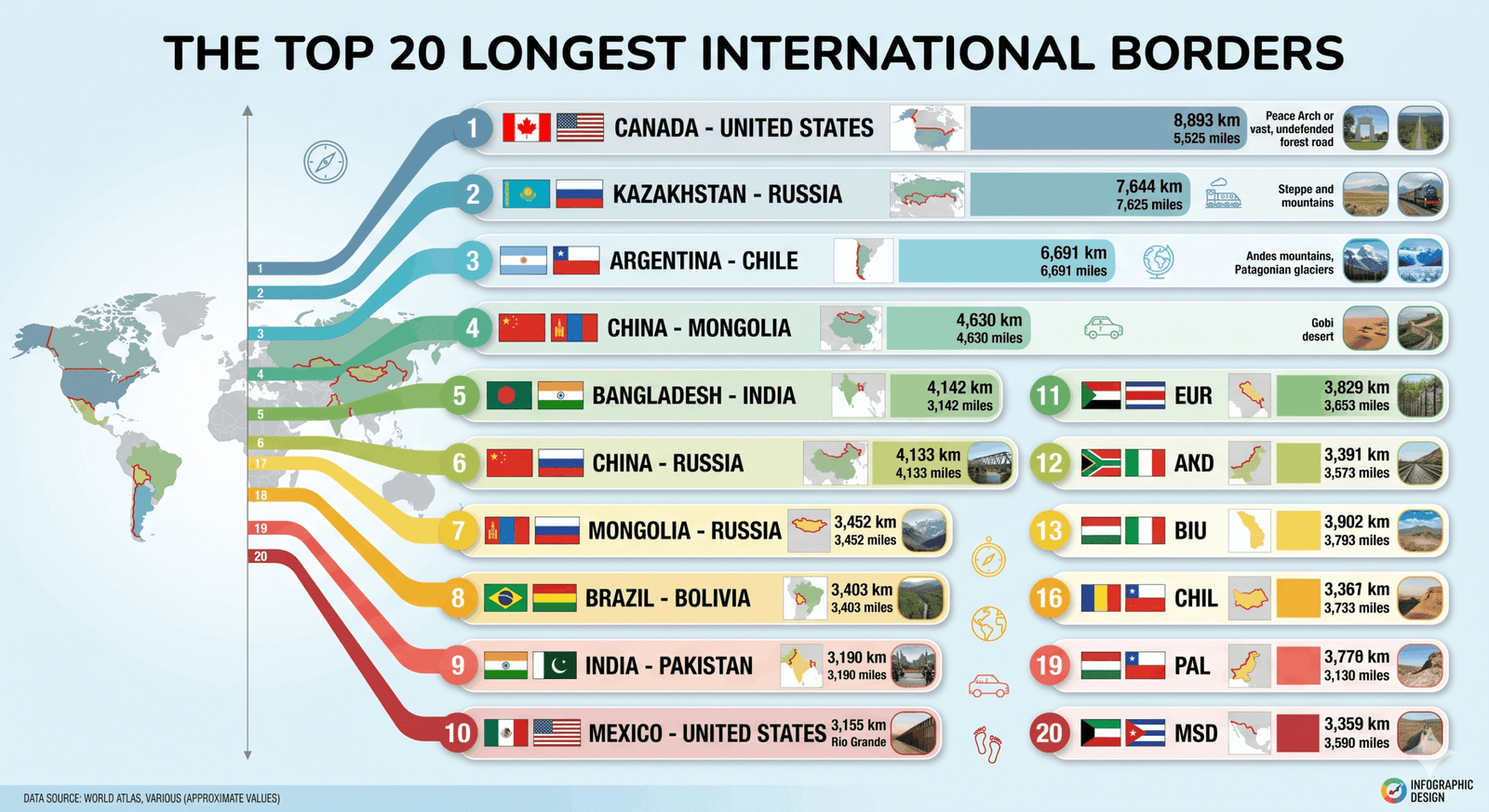
Borders are the defining limits of national sovereignty, often reflecting the results of diplomacy or historical shifts. Across the globe, these boundaries stretch through frozen tundras, dense rainforests, and scorching deserts. From the expanse between Canada and the United States to the rugged Himalayan peaks, the following are the 20 longest international land borders in the world.
1. Canada – United States
Length: 8,891 km (5,525 miles)
The Canada–U.S. border is the longest in the world. It is divided into two main sections: the border between the contiguous United States and Canada (6,416 km) and the border between Alaska and Canada (2,475 km). Known for being the longest undefended border, it traverses 13 U.S. states and seven Canadian provinces and territories.
2. Kazakhstan – Russia
Length: 7,644 km (4,750 miles)
Stretching across the vast Eurasian Steppe, this is the longest continuous land border in the world. Established as an international boundary following the dissolution of the Soviet Union, it remains a critical corridor for trade and energy between Europe and Central Asia.
3. Argentina – Chile
Length: 5,308 km (3,298 miles)
This South American boundary largely follows the spine of the Andes Mountains. It is a dramatic landscape of glaciers, volcanoes, and the Patagonian ice fields. Despite its length, much of the border is sparsely populated due to the extreme terrain.
4. China – Mongolia
Length: 4,630 km (2,877 miles)
This border runs through the heart of the Gobi Desert. Historically a region of nomadic movement, it is China’s longest land border with any single neighbor.
5. Bangladesh – India
Length: 4,156 km (2,582 miles)
One of the most complex borders in the world, the India-Bangladesh boundary is characterized by its winding nature through river deltas and dense populations.
6. China – Russia
Length: 4,133 km (2,568 miles)
The China–Russia border is divided into two non-contiguous sections: the long eastern section and a much shorter western section. The Amur River serves as a natural boundary for a significant portion of the eastern stretch.
7. Mongolia – Russia
Length: 3,452 km (2,145 miles)
Running mostly through the Siberian wilderness and northern Mongolian steppes, this border is characterized by its remote, rugged beauty and the historical influence of the Trans-Siberian Railway.
8. Bolivia – Brazil
Length: 3,403 km (2,115 miles)
This border winds through the Amazon rainforest and the Pantanal wetlands. It is a vital region for biodiversity but faces challenges regarding cross-border movement in dense jungle.
9. India – Pakistan
Length: 3,323 km (2,065 miles)
Often cited as one of the most heavily militarized borders in the world, this line includes the disputed region of Kashmir and the famous Wagah border crossing.
10. Mexico – United States
Length: 3,145 km (1,954 miles)
Stretching from the Pacific Ocean to the Gulf of Mexico, this border follows the Rio Grande for a large portion of its eastern half and is a focal point of North American political and economic discussion.
11–20: The Global Runners-Up
While the top ten receive the most attention, the following borders are equally significant in their respective regions:
| Rank | Countries | Length (km) | Key Geographical Feature |
| 11 | Brazil – Peru | 2,995 | Dense Amazonian jungle |
| 12 | China – India | 2,659 | The Himalayas |
| 13 | Angola – DR Congo | 2,646 | Tropical savanna and forest |
| 14 | Afghanistan – Pakistan | 2,643 | Rugged mountain terrain |
| 15 | Algeria – Morocco | 2,219 | The Sahara Desert |
| 16 | Colombia – Venezuela | 2,219 | Orinoco River and Andes foothills |
| 17 | Sudan – South Sudan | 2,184 | Nile River basin and plains |
| 18 | Brazil – Venezuela | 2,137 | Remote tepuis and rainforests |
| 19 | Mali – Mauritania | 2,237 | Dry Sahel and Saharan sands |
| 20 | DR Congo – Zambia | 1,930 | Southern African Plateau |
The Nature of “Length”
Measuring a border is more difficult than it seems. Geographers often refer to the “Coastline Paradox,” which suggests that as the scale of measurement becomes smaller and more detailed, the measured length of a winding line increases. For example, the India-Bangladesh border is so winding that its practical length for management is much higher than a straight-line map would suggest.
Why Do Long Borders Matter?
Long borders present unique challenges for nations:
Security: Maintaining a presence over thousands of kilometers requires immense resources, often leading to the use of satellite surveillance.
Trade: Longer borders often provide more points of entry, facilitating economic exchange between neighbors.
Ecology: Many of the world’s longest borders bisect critical ecosystems, requiring cooperation to ensure wildlife can migrate freely.
From the frozen north of the Americas to the tropical heart of Africa, these twenty boundaries represent the incredible scale of the world’s political geography.
- Follow me on TikTok for quick tips and behind-the-scenes tours
- Subscribe to my YouTube channel for in-depth videos and property showcases
- Follow me on Facebook for updates, listings, and real estate advice
